Strategy Brief
Moving beyond the "Big Bang" launch: How establishing a "rhythm of relevance" helps firms win the shortlist before the first sales call.
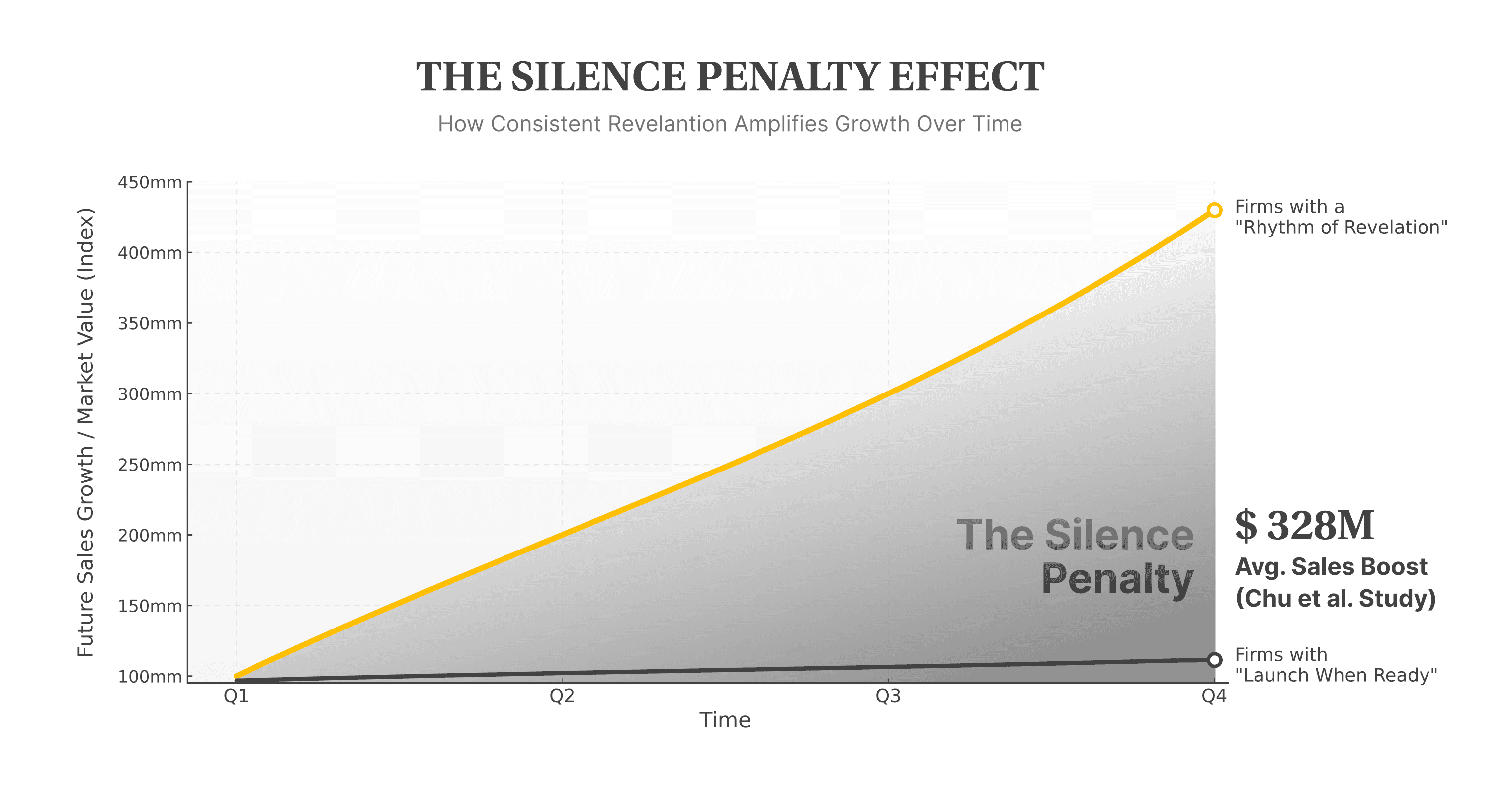
Executive Summary For decades, the conservative wisdom in B2B management has been to "underpromise and overdeliver." Executives are often advised to keep product roadmaps secret to protect IP and manage customer expectations. New research suggests this approach is now a liability. A convergence of academic data and modern buyer psychology reveals a new truth: Silence is a short position on your own future.
By analyzing over 30,000 corporate announcements alongside modern buyer behavior, we find that companies that maintain a "rhythm of relevance"—consistently broadcasting not just what they have, but what they are building—realize significantly higher sales growth, stock valuation, and marketing efficiency.
The Shift: Buyers Are Purchasing Trajectories, Not Just Tools
The modern B2B buyer has evolved. According to Blue Whale Research, a significant segment of the market—specifically the "Innovative Leader" persona—prioritizes future competitive advantage over immediate utility. These buyers are not just solving a current inefficiency; they are hedging against obsolescence.
The data reveals a stark reality for the "stealth mode" enterprise:
The Shortlist Gap: 80% to 90% of B2B buyers have already formed a shortlist before they ever contact a vendor. If your innovation narrative isn't public, you aren't just losing the deal; you aren't even entering the room.
The Feature Trap: Over half (56%) of buyers research new vendors specifically because a competitor’s product appears "more feature-rich."
The Fear of Missing Out (FOMO): "Innovative Leader" buyers are driven by the fear of being left behind. They require a visible roadmap to validate that a partner is future-proof.
In this environment, a "quiet" product strategy signals stagnation. The market interprets a lack of announcements not as "focus," but as a lack of R&D velocity.
The $328 Million Argument for "Loud" Innovation
While market sentiment is soft data, the financial returns of innovation disclosure are hard numbers. A 2024 study by Chu, He, Hui, and Lehavy analyzed the text of over 30,000 new product announcements to measure the economic impact of detailed innovation disclosure.
The results defy the traditional "protect your trade secrets" logic:
Revenue Impact: A one-standard-deviation increase in the detail of innovation disclosure is associated with a $328 million increase in future annual sales for the average firm.
Market Valuation: The stock market reacts 23% more positively to announcements rich in innovation detail compared to generic launches.
Marketing Efficiency: Firms that disclose more innovation detail see a reduction in Selling, General, and Administrative (SG&A) expenses. Why? Because a compelling product narrative does the heavy lifting, reducing the cost of customer acquisition.
Crucially, this "Innovation Premium" exists independent of actual R&D spend or patent counts. It is not enough to be innovative; the market rewards the communication of that innovation.
The Strategy: Establishing a "Rhythm of Relevance"
To capitalize on this, B2B leaders must abandon the "Big Bang" launch model—where silence reigns for 18 months followed by a single press release—and adopt a continuous disclosure rhythm.
1. Announce the "Work in Progress" The academic data shows that innovation disclosure predicts future earnings because it reduces information asymmetry . By sharing the direction of your R&D, you validate the customer's decision to invest in a long-term partnership. The study found that "forward-looking" disclosure helps customers understand the value of the innovation before it even hits the shelf.
2. Detail Matters It is not enough to say "we are launching a new tool." The Chu et al. study utilized a dictionary of specific innovation terms (e.g., "revolutionary," "autonomous," "pioneering") and found that the richness of the language correlated with stock performance. B2B buyers are sophisticated; they want the technical "how," not just the marketing "what."
3. The Governance Check Why don't more firms do this? The research highlights a "Credibility Trap." The positive impact of disclosure vanishes when managers have weak governance or selfish incentives (e.g., pending insider trading or golden parachutes). If the market suspects you are hyping a product just to boost the stock price for a quick exit, the premium disappears. The rhythm of announcements must be grounded in genuine R&D milestones, not vaporware.
Conclusion: The New Mandate
In a market where 90% of the buying decision happens before the first sales call, your public narrative is your primary sales force. The data is clear: Companies that treat their product roadmap as a state secret are effectively taxing their own future growth.
To win the "Innovative Leader" buyer, you must prove not only that you can solve their problem today, but that you are already building the solution for the problem they will have tomorrow.
Dec 12, 2025