Strategy Brief
New data shows that silence about future innovations is costing firms a $328 million sales premium—and missing the shift in enterprise buyer psychology.

In Brief
The Trap of Silence
Most B2B firms operate on a "launch when ready" cadence, keeping future innovations secret until they are perfect. This is a strategic error.
The Buyer Reality
New data shows that enterprise buyers are actively hunting for "industry trends" and monitoring "competitor adoption" long before they issue an RFP.
The Valuation Premium
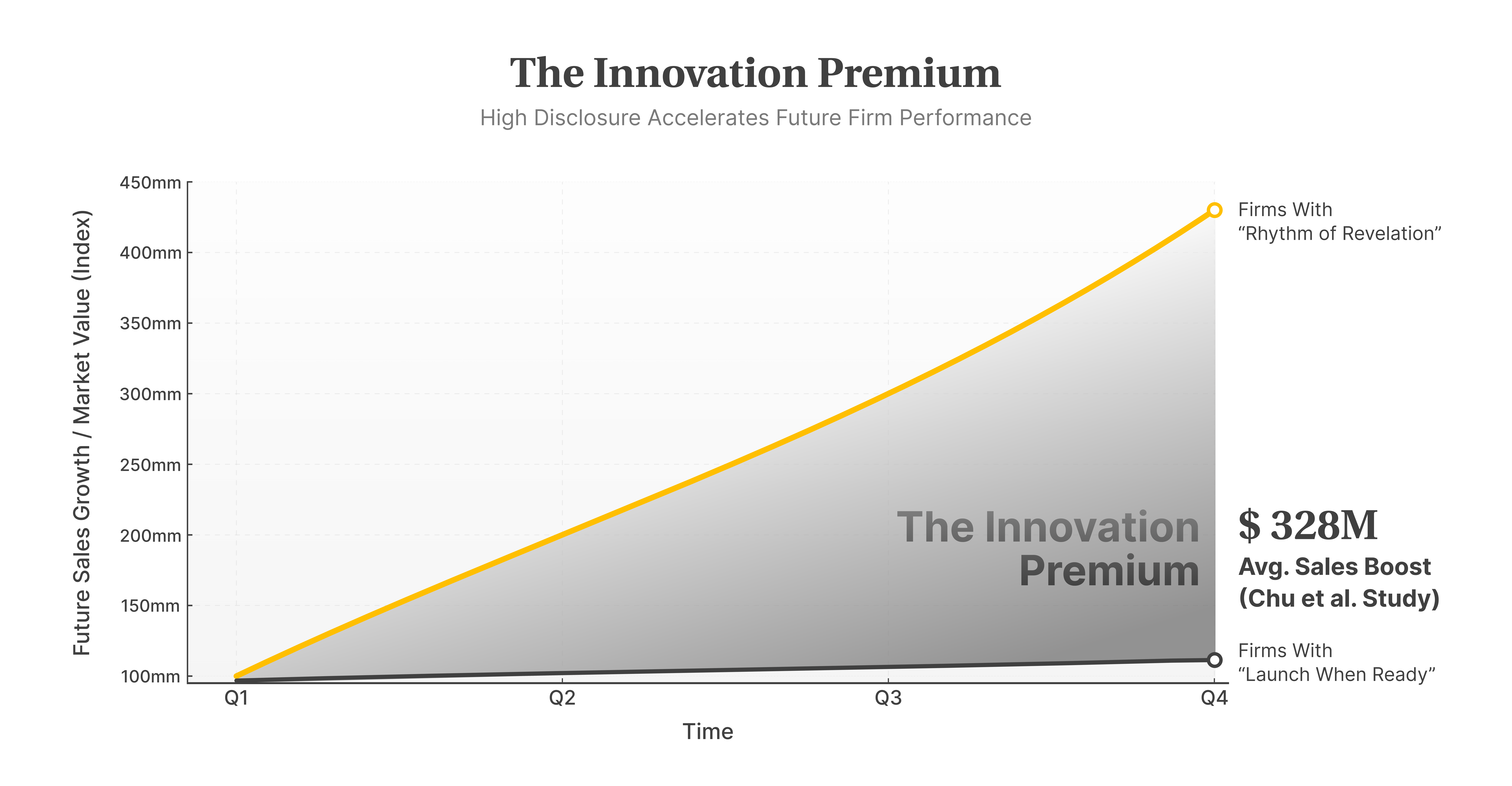
Academic research confirms that a consistent, high-volume rhythm of innovation disclosure doesn’t just build hype—it predicts a $328 million increase in future sales for the average firm.
The "Silent Builder" Trap
For decades, the prevailing wisdom in B2B product development has been "under-promise and over-deliver." Engineering teams toil in silence, marketing teams wait for the full release and executives fear that discussing a roadmap prematurely will vaporize trust or tip off competitors.
New market data suggests this silence is not just cautious—it is expensive.
In a market where buyers are increasingly motivated by competitive pressure and fear of obsolescence, the "Silent Builder" strategy cedes the narrative to vocal competitors. To capture the highest-value demand, firms must shift from a sporadic launch schedule to a Rhythm of Revelation—a consistent, strategic cadence of announcing not just what is sold today, but what is being built for tomorrow.
The Enterprise Buyer is Hunting for "Next"
Why do B2B buyers start researching a new solution? The conventional answer is "to fix a broken process."
However, recent data from Blue Whale Research reveals a bifurcation in buyer motivation that many sellers miss. While smaller companies (<5,000 employees) indeed prioritize "efficiency" and "cost," the motivations shift dramatically as organizations scale.
For Large Enterprises (>$1B revenue)—the whales most B2B firms are hunting—the primary triggers for research shift toward "Industry Trends" and "Competitors adopting new technologies."
In the technology sector specifically, buyers are obsessed with the competitive landscape. They are not just looking for a tool that works; they are looking for a platform that ensures they don't fall behind. If your firm is silent about its future, you are invisible to the buyer who is researching the "future state" of their industry.
The $328 Million Narrative Premium
Skeptics often argue that announcing "what’s next" is mere fluff—marketing noise that savvy investors and buyers ignore. A 2024 academic study published in the Review of Accounting Studies proves the exact opposite.
Researchers analyzed thousands of new product announcements (NPAs) to measure the impact of "Innovation Disclosure"—the depth and frequency with which management discusses the specific innovative aspects of their offerings. The results were quantifiable and significant:
The Sales Lift: A one standard-deviation increase in innovation disclosure is associated with a $328 million increase in next-year sales for the average firm.
The Stock Reaction: The market reacts 23% more positively to announcements rich in innovation detail compared to standard press releases.
The "R&D" Myth: Crucially, this effect holds true even for firms that do not report heavy R&D spend or patent activity.
The implication is clear: The market (and the buyer) cannot value what it cannot see. High R&D spend without a corresponding narrative is a wasted asset. The winners are not just those who innovate, but those who effectively signal their innovation to the market.
Strategic Imperative: The Signal Cadence
To capitalize on this, B2B leaders must abandon the "Launch and Leave" approach. Instead, they should adopt a three-tier signaling cadence designed to satisfy the "Trend" hunter identified in the Blue Whale research while capturing the financial premium identified in the academic study.
The "Now" Signal (Validation)
Focus: Commercial Availability. Target Audience: The Efficiency Buyer (Blue Whale data: <5k employees). The Tactic: Traditional product launches. However, per the academic findings, these must go beyond "features." They must articulate the degree of innovation—explicitly contrasting the new method against the old to maximize the "Innovation Disclosure" score.The "Next" Signal (Anticipation)
Focus: Beta programs, "Coming Soon," and Roadmap Updates. Target Audience: The Competitive Buyer (Blue Whale data: Software Sector). The Tactic: Announce the intent to solve a problem before the solution is perfect. This signals to the enterprise buyer that your platform is the correct vessel for their future budget. It prevents them from churning to a competitor who claims to be "working on AI," even if your AI is better but currently secret.The "Horizon" Signal (Vision)
Focus: Research partnerships, white papers on future trends, and "Visionary" press releases. Target Audience: The Investor and the C-Suite. The Tactic: This is where you capture the "Industry Trend" traffic. By publishing research on problems you haven't solved yet, you position your firm as the architect of the industry's future.
Conclusion: Silence is a Short Position
In a volatile market, silence is effectively a short position on your own future. If you are not talking about your roadmap, the market assumes you don't have one.
The data is now undeniable: The firms that win are those that treat their narrative as a product in itself. They recognize that in the eyes of the enterprise buyer, the promise of future innovation is often just as valuable as the current utility of the product.
It is time to open the doors of the R&D lab and let the market see what is coming.
Jan 23, 2026